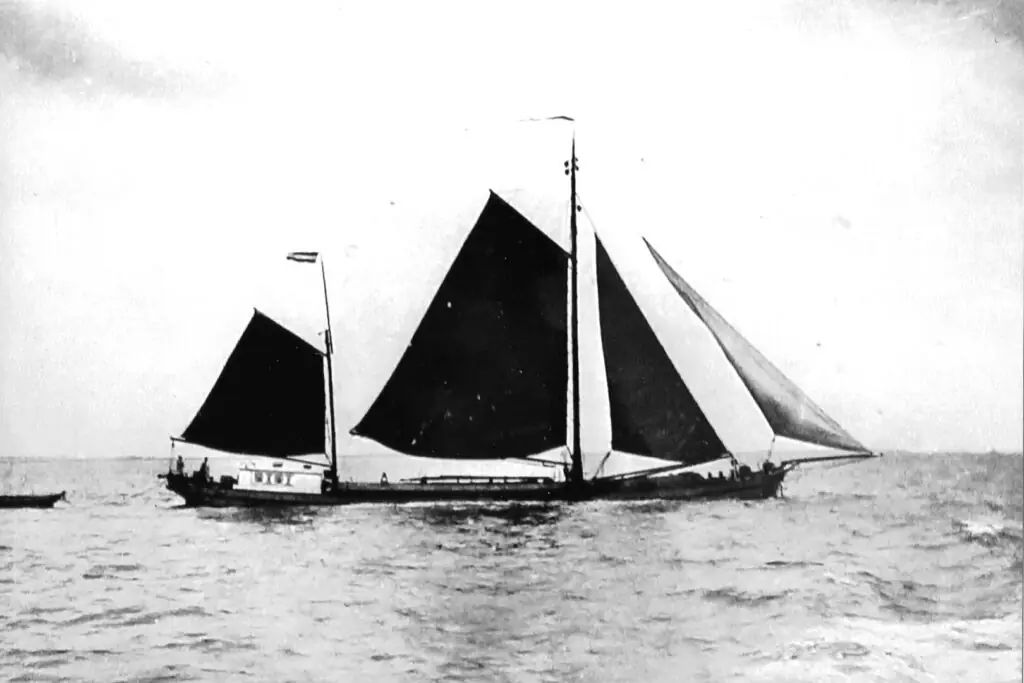
Johanna Engelina is a Dutch clipper built in 1897 by Borsius & v.d. Leye in Middelburg as Daniël Jacoba. This story traces her journey from sailing cargo vessel to charter ship through the Viergever, Theunisse and Toxopeus families.
Johanna Engelina ·
The short version of this story is on the history page. Below is the whole of it, as recovered from bills of sale, ship's mortgage deeds, measurement certificates and newspaper reports — with the names, the sums and the dates included.
1897 — The commission
The ship was launched in Middelburg on 27 November 1897 under the name Daniël Jacoba. She was commissioned by Jan Hendrik Viergever, born on 18 April 1873 in St. Annaland, who named her after his parents: Daniël Viergever and Jacoba de Vin. She was built by the yard Borsius & v.d. Leye in Middelburg. Her dimensions were then 37,45 by 6,84 metres, with a draught of 1,91 metres and a cargo capacity of 273 tonnes.

What the deeds tell us
On that same 27 November, Jan Hendrik signed the bill of sale for his ship. It was registered in Zierikzee on 1 December 1897. The ship's mortgage deed of 30 December 1897 shows what the purchase cost him: he borrowed ƒ 9,000 for it. His father Daniël Viergever and his brother-in-law Benjamin de Witte stood surety. It is these papers that make the ship's story so precise — the dates below come from the deeds themselves, not from hearsay.
Built for rough water
Jan Hendrik deliberately chose a heavy, robust ship. He wanted to carry cargo between what were then the Zealand islands, and those waters were known for their turbulent character; only a seaworthy ship lasted long there. The Daniël Jacoba was accordingly given generous dimensions and, above all, heavy construction and thick plating. During recent refits we came across structures here and there that would not look out of place on a true seagoing ship, and measurements showed the hull is still 8 millimetres thick in places.

Cargo under sail
After her launch the Daniël Jacoba carried bulk goods: sand, manure, grain and other agricultural produce. This was done entirely under sail. Only in the 1930s was an engine fitted, and the sails disappeared one by one.

Pieter Theunisse comes aboard
On 13 January 1898 Jan Hendrik married Pieternella Theunisse. Her brother Pieter Theunisse soon came aboard as a hand, and after a few years sailed the Daniël Jacoba as skipper himself in the scheduled cargo trade. On 27 July 1911 he was able to buy the ship. He was given a discount on the price on one condition: the name was not to change. Shortly afterwards he met Jenneke Pieterman, whom he married. Several children came of that marriage; Jan and his sister kept sailing into the 1960s.

The war years at Haaften
The ship kept sailing through the war until the end of 1944. It was then decided to set her dry at extreme high water in a dead arm of the Waal near Haaften. She was indeed confiscated by the Germans, but they could not get her out of there. That is precisely why she was spared and could carry cargo again soon after the war.

1945 — Afloat again
When the war was over the ships were refloated. A short report about it appeared in the newspaper, alongside a notice from the Theunisse family: a word of thanks to the villagers of Haaften for their help.
1948 — Jenneke sails on
On 14 December 1948 Pieter Theunisse died unexpectedly. The ship passed to his widow, Jenneke Pieterman. She sailed on with several of her children: son Jan and daughter Pietje helped in particular, daughter Dina kept house, and eldest son Bram was by then sailing as a hand on another ship.

The lame arm, and what followed
In 1949 the masts were taken out of the ship and a horizontal 18 hp Deutz was fitted on the foredeck. At a maximum of 6 kilometres per hour, that lame arm made sailing considerably easier. In 1958 the Deutz was replaced by a 100 hp Daf, cargo capacity rose to 336 tonnes, and a wheelhouse was added on the afterdeck.

1969 — Jan Theunisse and the Pieter T.
In 1969 Jan Theunisse took the ship over from his mother. He renamed her Pieter T., after his father. Jan mainly carried animal feed, sometimes dry sand or gravel, and stayed inland while doing so — never across the IJsselmeer. In 1973 he sold the ship to S.C. van Utrecht.
Renamed five times
According to the measurement certificate the ship changed name five times between 1960 and 1977: from Daniël Jacoba to Pieter T., to Jo-Ba, to Rita, to José and finally to Johanna Engelina.

The grief behind the sale
In the late 1970s Jelte and Annelies Toxopeus bought the José. They found the ship at Nederhorst den Berg on the Vecht, where she was in use as a transhipment vessel with a large crane on the foredeck. The reason she was for sale was tragic: the seller's daughter, José, had died in a traffic accident a few months earlier. Overcome by grief, her father wanted nothing more to do with the ship that carried her name.
From houseboat to sailing clipper
Jelte and Annelies first used the ship to live on. Jelte worked for Rijkswaterstaat on the Delta Works, so their home could be moored next to the job each time. Gradually the ship was rebuilt and transformed into a charter ship and sailing clipper. It was in those years that they gave her the name she still carries: Johanna Engelina, after both their mothers.
1994 and 1998 — To the present skipper
The ship stayed in their hands until 1994. Putting their two new ships, the Nirwana and the Waterwolf, into service made them decide to sell the Johanna Engelina. Jan Schoen became the new owner, until Laurens Sinaasappel took her over from him in 1998. She has sailed under his command ever since.
The ship as built
- Launched
- 27 November 1897, Middelburg
- Yard
- Borsius & v.d. Leye
- First name
- Daniël Jacoba
- Commissioned by
- Jan Hendrik Viergever
- Dimensions at delivery
- 37,45 × 6,84 × 1,91 m
- Cargo capacity 1897
- 273 tonnes
- Cargo capacity after 1958
- 336 tonnes
- Purchase sum 1897
- ƒ 9.000,- borrowed
About this text
This text adapts the historical account on the former Johanna Engelina website. That account refers to ownership declarations, ship mortgage deeds, measurement certificates and newspaper reports. The original documents are not reproduced on this page; this is a historical narrative, not a transcription of the deeds.